Monday, 23 May 2016

Enchanting Evora

Getting to Evora was a little trickier than getting to Sintra. While the trains leave every 20 minutes all day long for Sintra, there are only two trains a day coming and going to Evora. Since we didn't want to get up early enough for the 7:30 train, that meant that if we missed the 9:30 train, we would be out of luck! This added a bit of stress (oh no!) to our relatively relaxed trip. We managed to take the subway, transfer to another line, stand in line waiting for our ticket while some crazy Canadian woman played 20 questions with the ticket seller (grrr), and finally got on the train with only a few minutes to spare! (phew)

The 1 1/2 hour trip sped quickly by, as we enjoyed the countryside along the way.


Evora is a UNESCO World Heritage Site with a rich history dating from the Romans in the 2nd century B.C. to the 4th century A.D., followed by the Moors from the 8th to the 12th century. This was an area rich in silver and wheat, and was a popular stop on the trade route to Rome. This was also a popular city for the kings of the 15th and 16th centuries, with some making it their home.

The ancient city wall is still standing, with gates that you have to pass through to get to the old part of the city. We loved that everything in the city was an easy walk from the main square, with the streets fanning out like spokes on a wheel from the city center.


Our first stop was the Church of St. Francis. Bryce was eager to see this, because he had heard that there was a bone room, and he still hasn't gotten over missing out on the catacombs when we were in Paris. It was absolutely fascinating, because it contains the bones of thousands of people who were dug up from the local graveyards. This was the brilliant idea of three monks who believed that they needed to provide a place for people to ponder the important things of life in the face of the certainty of death. Inscribed in the chapel is this little poem:

 The scraggy skulls
Are my company
I have them night and day
In my memory
Many were honoured
In the world by their talents,
And other vain ornaments
Which served vanity
Maybe in Eternity
The reason of their torments.
 Above the entrance to the bone chapel is a message that translates: "We bones in here wait for yours to join us." Hmmm, wonder how that might go over in one of our churches today!


The church is surprisingly ornate, considering the simplicity of life that St. Francis advocated. All the gold is a sign of the 18th century when gold was being brought back from Brazil by the boatload.

From here, we flagged down a taxi and headed out of town, down potholed roads for an hour to go see the megaliths. I was so excited to see these, as I have wanted to see Stonehenge since I read about it in my Social Studies textbook as a kid. Apparently it is no longer possible to get close to the megaliths in England, as they have been fenced off, but here in Portugal, they were surprisingly simple and accessible! These date from about 5,500 B.C. Now, that's old! This is 2,000 years older than Stonehenge! Wow! Wow! Wow! After watching "Outlanders", I thought I better touch one of them to see if I might be transported back to Medieval times to fall in love with a handsome prince, but nothing happened. I guess I'm stuck with handsome Prince Bryce!
Cork trees growing in the area


It's hard to believe that these megaliths weren't discovered until the 1960's. Although it is believed that the megaliths had a great sacred and symbolic nature, their function is still uncertain. The location of them does suggest a relationship to the sun and the moon, and it is thought that this was a sacred place where communities in the region would gather to celebrate the great cycles of nature.


Ancient writing on the petroglyphs


Once our taxi took us back to town, we enjoyed a late lunch in one of the small sidewalk cafes, then set off to explore, yes, another cathedral, The Cathedral of Evora! Oh, the fun never ends! This one had a museum attached to it full of historical religious artifacts. I almost got my hand slapped by the docent at the entrance when I tried to take a picture of the sign, though. In the most stern voice, "No pictures!" Bryce and I were kinda scared of her, so we skedadled out of there as fast as we could!


We did enjoy the views from the top of the cathedral, and Bryce didn't even complain too much about climbing another 600 stairs to the roof!


Next to the megaliths, my favourite site was the Roman Temple. More big wows! This temple has 14 Corinthian columns, and if we closed our eyes, we could almost hear the sounds of the Roman forums that took place here during the 1st century!

Although there was much more to see, we were running out of steam, and decided that we better grab that last train back to Lisbon. Our only regret was that we didn't have another day to enjoy this enchanting city!


Sunday, 22 May 2016

Leaving Lisbon: A Day Trip to Sintra

Sintra dates back to Neolithic times between the 4th and 3rd century B.C. Around 49 B.C., this area became part of the Roman Galeria. During the Moorish occupation, the population became more established and connected with Lisbon, 15 miles to the west. Although this was a difficult trip during Roman and Moorish times, we were able to reach it by train from Lisbon in only 45 minutes.
Coming into the train station, we were greeted by quaint houses, restaurants and gift shops. The entire area has been designated a UNESCO World Heritage Site, and we were excited to take a look at the many castles and churches in this relatively small town.
Pena Castle

Although it is possible to walk up the mountain to the castles, it is straight up for at least 1 1/2 hours, and both Bryce and I have put our hiking days behind us! A few Euros bought us a seat on the tour bus and we were on our way along the road that snaked back and forth in tight hairpin turns. At one point, the bus even had to stop and jockey back and forth a few times in order to make the turn!  Once we arrived at the Palace and gardens of Pena, the wind was so strong and cold that we had to buy sweatshirts, or we would have become one of the many frozen statues in the courtyard!

The gardens are a spectacular display of horticultural delight covering almost 85 hectares of land. Considering that this land was barren when the castle was built, this is an amazing accomplishment.


Even more amazing was the castle, which was built in sections, beginning with a chapel, built in the 12th century. In the 15th century, a convent was built on the site, which was selected due to its isolated location atop a mountain. In the 18th century, King Ferdinand II decided that this site would be the ideal spot for a palace, and undertook this project for his family to escape the summer heat of Lisbon.


Nave of the chapel
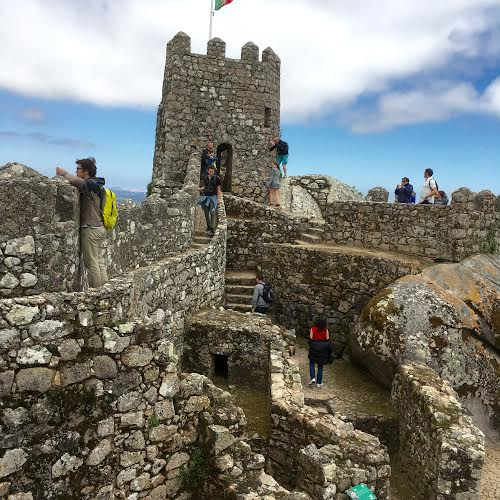
The oldest castle in Sintra is the Moorish Castle, but only the wall is still left standing. This was built around the 10th century and with its position high on the hill, offered great views of both the Atlantic and the land to the north, serving as both a strategic defense and an outpost to Lisbon. Walking along the wall was an exhilarating experience, thinking about the people who must have walked here over 1100 years ago, but my favourite was the beautiful gardens, with the birds singing and gigantic boulders lining the path.


By the time that we had visited the two castles, we were happily worn out and ready to head back to our little apartment in Lisbon, but were determined to come visit Sintra again before the end of our trip.


View from the castle wall


Thursday, 19 May 2016

Loving Lisbon Day 7: A River Cruise

Christ the King stands guard over the river
We were excited to take a cruise on the Tejo River in order to gain a better understanding of this incredible artery of Lisbon life. It was a nice relaxing way to start our day as we viewed all the sites that we had already explored on land.

The Christ the King statue was modelled after the much larger Christ the Redeemer statue in Rio de Janeiro as a way to mark the Portuguese peoples' gratitude for being spared the devastation of World War II.

Belem Tower


After the cruise, we returned to the Carmo Convent Ruins in order to enjoy the many artifacts housed inside. This church was built in 1389, but was destroyed during the earthquake of 1755. Fortunately for us, the decision was made to leave the church standing in its ruined state as a reminder of the disaster. It is an awe inspiring structure, with much of the interior intact, but the roof open to the sky, leading one to look up in wonder. It makes me think that maybe all churches should be open air!


The roof of the nave was eventually replaced, allowing for the creation of a museum, which carries relics from as early as the 4th century, including pieces from Moorish and Roman times.


Wednesday, 18 May 2016

Loving Lisbon Day 6: Awesome Aquarium


I haven't been to the aquarium since my own children were small, and since my big kid was excited to see the largest indoor aquarium in Europe, we set off to see the Lisbon Aquarium. Since it was a beautiful sunny day, we enjoyed strolling the grounds and the river walk that Expo 98 once occupied.


The Lisbon aquarium is the largest indoor aquarium in Europe, housed in two buildings, one a temporary exhibit, created by different artists from other countries, and a large permanent exhibit, which is the most beautiful that I have ever seen. Every imaginable fish is represented, with the tropical fish in an 180,000 cubic foot tank with windows on two floors, allowing for easy visibility from every angle. My favourite was the sunfish, as I have never seen one of these before! It is very odd looking, one of the largest fish in the tank, looks almost square, and doesn't appear to have a tail at all!


There were also some interesting species in smaller tanks around the outside wall of the aquarium, such as seahorses, anemones and jellyfish.


After leaving the aquarium, we rode the overhead gondola to the opposite end of the park and caught our bus home for a rest before heading out for the evening.


Our evening walk included many, many stairs, as we wanted to climb to where the church ruins were and catch some great photos in the setting sun. As the church was closed for the day, we would have to return tomorrow in order to enjoy the treasures held inside.


Tuesday, 17 May 2016

Loving Lisbon Day 5: The Tower of Belem

At first the idea of taking a walk through the history of Lisbon in the Story Center seemed too juvenile for such wordly folk as Old Brycey and Arly, but since the Tourist Office is located there, and we had returned several times, we finally decided it might be worth a try. We were so glad we did, as this turned out to be one of our favourite activities so far! The Story Center walked us through several different scenes with an audio guide, telling us the story of how Lisbon was originally settled, showing a full screen movie of the earthquake that made us feel like we were actually there, and experiencing the rebuilding of the city. We always come away from a trip with a much better understanding of the history of where we have been, but nowhere has this been more true than in Lisbon!
We thought it was a castle, but it's a prison!


Since we had run out of time when we were out in Belem, we hopped back on the "Hop on Hop off bus" for another trip out to the most visited part of Lisbon. Along the way, we passed the aqueduct that was built in the 1700s. This incredible structure stretches 11 miles, and miraculously survived the earthquake!

Amazing Aqueduct


Once we finally reached Belem, we had to stop for lunch at one of the sidewalk cafes. To live is to eat here in Portugal! Mmmmmm, delightfully delicious! And, of course, a side trip to the Pasteis de Belem for the most tantalizing  custard tarts anywhere in the world! Sigh, I'll start the diet when I get home!


By the time we got to the tower, Bryce decided that he had to go admire some plumbing possibilities, but of course, that was a very long walk to the other end of the park, so I decided that I would stand in line while I waited for him. After what seemed like half an hour, I was at the front of the line, but still no Bryce! I gave up my place in line and just then, I finally saw him, but it was 5:00, and the guard had put the barrier across to prevent anyone new from joining the line. Oh no, this was the second time that we had come to see the tower, and we would have to miss it again!


"Please, kind sir, I've been standing here for half an hour and my poor husband had to go use the washroom, please let him in!" Thankfully, he took pity on us and allowed Bryce to enter. (There were a lot of people who weren't so lucky, though!)

The tower was built in the early 1500s as a first line of defense for the city, and it was well worth the trouble we went through to see it. Bryce opted to stay below while I climbed to the top to enjoy a 360 degree view of the river and the city.

Monday, 16 May 2016

Loving Lisbon Day 4: Awesome Alfama


The Alfama is one of the few areas in Lisbon that was not destroyed by the earthquake of 1755. How we loved exploring the narrow alleyways and walkways of this medieval village. We started at the train station where we bought our tickets to Porto for the 23rd. Luckily we are not at the height of the tourist season, as these tickets can sell out up to a month in advance! It was fun standing in line and noticing the backpackers buying tickets for points all over Europe, many of them pensioners like us but  in hiking boots and backpacks!

Bryce is like a kid in a candy shop in a train station, taking in all the sights and sounds, reliving his youth travelling across Canada working as a 2nd cook on the trains. Oh the stories he has to tell!

Hanging the wash out is common just adds to the charm!


We let ourselves be led along the street, not really sure where we were heading, when we came across a sign pointing uphill that said "Mercado" (market). "Didn't you say that there was a market here on Saturdays?" I said to Bryce as we began the long trek uphill. After about a mile walk all uphill, passing churches and enchanting houses, we finally came to the market that filled the square and many side streets.


Bryce was thrilled because he found a leather jacket for only 8 euros. Since it has been miserably cold, he eagerly grabbed it, and I had to listen to him carry on all day about how grateful he was for it!

From the market, we carried on downhill, taking our time to enjoy meandering along the charming back alleys and stairways that lead through the town. Since I didn't have a coat and was feeling the chill, we ate inside, skipping the many tempting sidewalk cafes. We decided this was our favourite meal so far, but we say that at every restaurant here, as the food is wonderfully delicious. Bryce enjoyed the seafood gumbo, while I had cod.

Tiled buildings are one of the many interesting aspects of Lisbon

We ended our afternoon in the Fado museum, where we learned all about this traditional Portugese musical art dating back to the 1820s with ancient roots thought to originate with the songs of the Moors. It reminded me of the beatniks, as the music was often anti-establishment, sung in bars and coffee houses, and looked on with suspicion by the government.. In fact, many of the singers were  jailed by the dictatorship ruling the country in the early 1900s, who censored the music and eventually placed strict regulations on its form.

After all that hill walking, we went home for a quick nap so that we could return fresh in the evening in order to enjoy the Fado in this delightful area. As we meandered along the narrow walkways, we were delighted to hear this expressive yet mournful music expressing loss and a hard life on the sea drifting  from almost every restaurant. It was easy to see why UNESCO has designated Fado as one of the Intangible Heritage forms.
View of the city from the top of the hill